
🔗Matrix Live S13E13 - Amandine & Matthew brace for the conference
🔗Dept of The Matrix Conference 🏛️
Andy announces
As you can see in Matrix Live this week, we are into the final few days before the Conference!
The event is a team effort, and we're very appreciative of the help of our volunteers (40 of you!). We have a couple of slots (and hoodies!) left if you're willing to help out - just take a look at the volunteer schedule. Maybe there is a free shift during a talk you want to see? How about you help film or record it! If you are willing and able to help out, book a slot!
We are also grateful to our sponsors - their contribution plays a critical role in the Foundation’s ability to run the Conference and progress towards sustainability in general. Thank you!
⚓ Anchor sponsor: Element
🏆 Champion sponsors: Connect2x, Famedly and Rocket.Chat
💪 Sustaining sponsors: DINUM, ERCOM and Nordeck
🍻 Welcome party sponsors: Famedly and CGM
📹 Video sponsor: Element
🚆 Community attendance sponsor: Famedly
📊 Track sponsors: CGM (Healthcare) and Element (Public sector)
💻 Hackathon sponsors: Futurewei and the University of Aalborg
We're looking forward to seeing many of you in Malmö and Copenhagen!
If you're not able to join us in person, we hope you'll be following along online.
See you soon!
Your Events WG
🔗Dept of Social Good 🙆
Amandine says
🇪🇺 Europe is working towards more Digital Sovereignty, and as such taking open source and digital commons at the forefront of regulation and political discourse.
From Tchap in France 🇫🇷 to BundesMessenger and openDesk in Germany 🇩🇪, via BEAM in Belgium 🇧🇪, LuxChat in Luxembourg 🇱🇺, and many more, Matrix underpins government communications across Europe: it makes it an obvious case study of how to scale digital commons. However, despite the popularity of Matrix, only one government agency, France's DINUM, commits to support the open standard they all rely on by being a member.
💡 That gap is exactly one of those the new Digital Commons EDIC (DC-EDIC) could close and with this truly impact Europe’s implementation of digital commons. Drawing on 12 years of building Matrix, we've set out how the DC-EDIC can make the most of its five goals, taking a leaf out of the World Health Organization's book. Our suggestions include:
Build a trusted index of open source projects and vendors
Pool funding across Member States
Fund the guardians of open standards, not just new code
Give policymakers real evidence on costs, privacy and security
… and more!
Europe doesn't lack open source builders. What it needs is a body that does the unglamorous work that keeps everyone's lights on.
Read our recommendations in this blog post.
🔗Dept of Spec 📜
Andrew Morgan (anoa) {he/him} announces
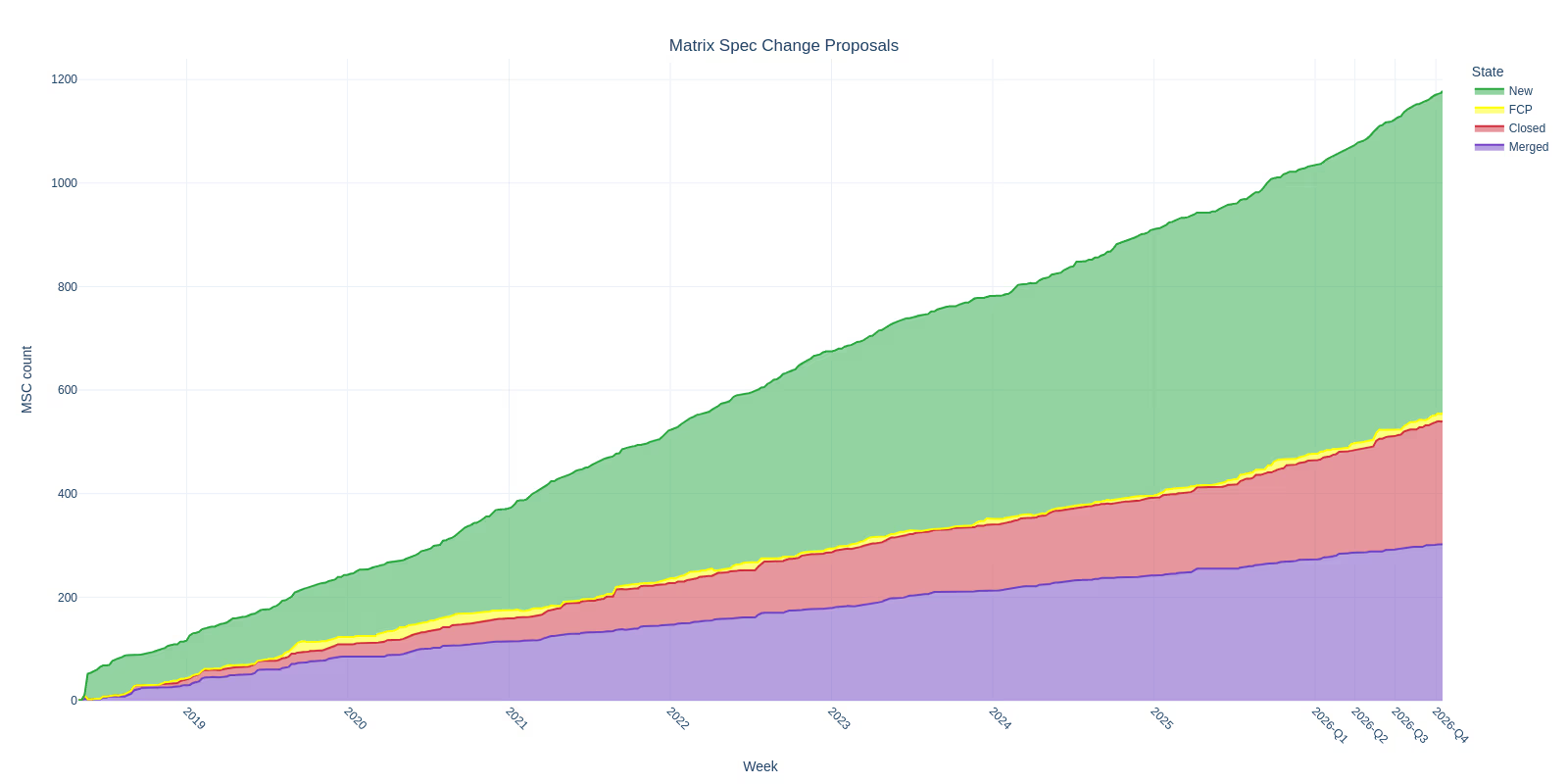
Here's your weekly spec update! The heart of Matrix is the specification - and this is modified by Matrix Spec Change (MSC) proposals. Learn more about how the process works at https://spec.matrix.org/proposals.
🔗MSC Status
New MSCs:
MSC4564: Agent status in room messages
MSC4563: direct_message push rule
MSC4560: Stripped state requests over federation
MSCs in Final Comment Period:
MSC4551: Sliding Sync Extensions: Receipts (merge)
MSC4548: Sliding Sync Extensions: Account data (merge)
MSC4543: Sliding Sync Extensions: End-to-end encryption (merge)
MSC4538: Sliding Sync Extensions: To-Device messages (merge)
MSC4354: Sticky Events (merge)
MSC4196: Voice and video calling application for MatrixRTC (merge)
MSC4195: LiveKit transport for MatrixRTC (merge)
MSC4143: MatrixRTC – Real-time communication over Matrix (merge)
Accepted MSCs:
No MSCs were accepted this week.
Closed MSCs:
MSC4076: Let E2EE clients calculate app badge counts themselves (disable_badge_count)
Ended up becoming a Sygnal config option.
[WIP] MSC3898: Native Matrix VoIP signalling for cascaded foci (SFUs, MCUs...)
Superseded by the MatrixRTC sphere of MSCs (MSC4143)
🔗Spec Updates
There's been a huge push in the last week to get Matrix 2.0 ready. A total of 187 comments across all Matrix 2.0 MSCs in the last week alone! A massive thanks to the authors and all of the reviewers for their work here.
The result is that 8 more Matrix 2.0 MSCs entered FCP this week! Sticky Events has received the most scrutiny, but both it and the implementation are now in a good place in the SCT's eyes.
🟢 MSC4140: Cancellable delayed events — Merged.
🟢 Clarifications for MSC4140: Cancellable delayed events — Merged.
🟢 MSC4354: Sticky Events — Entered FCP on 15 October, up from 2 / 8 approvals. Earlier implementation/testing, expiry and visibility concerns are cleared. Federation catch-up flicker and stale notifications are an explicitly accepted remaining risk, not a solved problem or outstanding blocker. Latest visible follow-up is an RTC example correction.
🟢 MSC4551: Sliding Sync Extensions: Receipts — Entered FCP on 13 October. Replaces the closed MSC3960.
🟢 MSC4538: Sliding Sync Extensions: To-Device messages — Entered FCP on 13 October.
🟢 MSC4543: Sliding Sync Extensions: End-to-end encryption — Entered FCP on 13 October. The token-acceptance feasibility question has been answered.
🟢 MSC4548: Sliding Sync Extensions: Account data — Entered FCP on 13 October. Discussion about implementation coverage for enabling/re-enabling and whether Synapse actually differs from the proposal remains open.
🟢 MSC4143: MatrixRTC – Real-time communication over Matrix — Entered FCP on 15 October. Implementation/migration discussion is now resolved. This week’s slot-ID versus event-ID concern was closed by reverting the proposed slot-event-ID addition. Sticky Events is no longer an outstanding dependency concern.
🟢 MSC4195: LiveKit transport for MatrixRTC — Entered FCP on 15 October. Abuse-mitigation discussion is resolved. A new mandatory-multi-SFU objection was addressed by allowing publishing to a remote SFU.
🟢 MSC4196: Voice and video calling application for MatrixRTC — Entered FCP on 15 October. The server-presets discussion is resolved in favour of client-managed slot creation.
🟡 MSC4480: Sliding Sync Extension: Sticky Events — Now proposed for FCP, 1 / 8 approvals. Blockers remain around room-scope transitions, enable/disable behaviour, long-poll wakeups and lazy-loaded membership for rooms leaving scope. Global pos is now incorporated, but how clients detect backlog exhaustion remains under discussion. Implementation also needs checking by the SCT.
🔴 MSC4075: MatrixRTC invites and notifications — Still in proposal review. Earlier invalid-event and slot-lifecycle questions have been addressed; cross-device ringing is now documented as a limitation, but not fixed. A new potentially blocking session-identity/simultaneous-invite question remains open. Sticky-object validation has an author response awaiting closure, and the PR still carries needs-implementation.
Given the 5-day FCP timer, we should see the majority of these actually become accepted by the conference 🎉 A couple MSCs are still outstanding (SS extension: sticky events and MRTC invites/notifications) but the core of everything is there, and those MSCs won't be left out of the 2.0 release.
For now, we can celebrate how much work has been put in to bring these exciting additions to the spec 🥂
🔗Dept of Servers 🏢
🔗Zendrite (website)
pat-s says
Zendrite, the Dendrite fork written in Go, released v3.5.0.
This release focuses on Element Call and on catching up with the spec.
Element Call
MSC4140 delayed events, which Element Call uses to remove crashed clients from calls, including delayed sticky events.
MSC4354 sticky events in sync v2 and sliding sync, which Element Call's matrix_2_0 MatrixRTC mode needs.
MSC4222 state_after in sync v2.
Optional call guest accounts, so people without a Matrix account can join a call by link without open registration; they can only take part in calls and expire after a configurable lifetime.
An end-to-end deployment guide covering LiveKit, lk-jwt-service, the standalone Element Call app and the Helm chart.
Spec support
/versions now advertises Matrix v1.3 through v1.6, which also unblocks bridges such as mautrix-telegram that refused to start against v1.2.
Jump to date (MSC3030) now asks other servers when local history may hide a closer event.
Custom profile fields (MSC4133), refresh tokens (MSC2918), room type filters for the public room directory (MSC3827), leave reasons (MSC2367), key backup deletion (MSC1219), and the remaining Matrix v1.2 MSCs.
Application services now receive redactions.
Fixes
Sliding sync timelines now apply history visibility, so users can no longer read messages from before they were allowed to see them.
Server ACL globs match against the whole server name.
Redacting v11+ member events keeps third_party_invite.signed.
The built-in NATS server is now 2.15.1, which fixes a broker replica that stopped catching up after rejoining on its old storage; HA deployments running their own brokers should upgrade them to 2.15.1 too, and the HA guide explains how to spot and recover a stuck replica.
Release notes: https://codefloe.com/pat-s/zendrite/releases/tag/v3.5.0
Chat: #dendrite:matrix.org
🔗Tuwunel (website)
Enterprise successor to conduwuit, the high-performance and feature-rich fork of Conduit.
june ✿ 🏳️⚧️ (it/she/puppy) announces
Tuwunel 1.9.4 stores media in Google Cloud Storage through asafarian's native media provider. On GCE or GKE, Tuwunel can get credentials from the metadata server instead of an exported key (setup).
With oidc_native_auth enabled, the Native OIDC authorization, account and device-login pages offer a choice of local password or configured SSO providers. tototomate123 built the provider choice at utop-top's request. Account pages gained the choice after utop-top's report that Element X's Manage Account jumped straight to SSO.
arnolicious added controls to limit profile reads to people sharing a room and prevent regular users from setting display names or creating room aliases.
obodnikov added per-account password limits, got JWT B64HMAC working, and ensured JWT login rejects deactivated accounts. The last admin can no longer be deactivated, and removing emergency_password clears the server user's sessions at next startup.
basnijholt fixed thread counts, root bundles and latest replies after redactions. MindRoom Chat kept fetching 13 pages for a thread of roughly 1,000 events because the count still included a redacted reply.
Federated key answers now keep only the answering server's users, and Sliding Sync withholds invited and knocked rooms' timelines.
Startup now repairs the short-id residue behind the repair refusal dogarrowtype reported. mav96 supplied a second log. Uncertain data is preserved.
az4521 fixed URL previews of kkinstagram.com links, and reported the room version 12 create events that caused problems for force-set-room-state-from-server. Thanks to morteng's report, a mistyped !admin users reset-password no longer creates state.
SatvikMishra08 fixed the federate_created_rooms documentation issue edenworky reported. June refreshed dependencies and moved OpenTelemetry to 0.33.
Notes: https://github.com/matrix-construct/tuwunel/blob/f473d9a4a8342514302884041e0ccfea1ad503fc/RELEASE.md
💕 GitHub ✦ Releases ✦ DockerHub ✦ Playbook ✦ Containers ✦ Documentation ✦ Enterprise 🐕️ Tuwunel 💕
🔗Synapse (website)
Synapse is a Matrix homeserver implementation developed by Element.
madlittlemods (Eric Eastwood) says
This week we have a new release, Synapse 1.163.0. To highlight:
We can finally see light at the end of the tunnel with our Matrix v1.17 project. Synapse now advertises support for Matrix v1.14 and v1.15 (#20137, #20286), and Matrix v1.16 and v1.17 will come as part of the next release (already merged). Of course, the spec keeps evolving, so the march isn't over, but we've accomplished the concrete goal we set out for this quarter! 🎉
The experimental MSC4354 Sticky Events implementation got a number of updates to improve robustness. Synapse now catches up remote homeservers with any sticky events they may have missed (#20165), handles sticky events being redacted (#20232), makes sure new joiners know about all sticky events in the room (#20233), and uses sharded tokens to prevent race conditions when using workers (#20186).
Fixed an edge case where the push badge count could undercount. Because it needs specific conditions and because most clients calculate the badge count themselves, this might not be a very commonly visible problem in the wild, but it fixed a Complement test flake that has been plaguing us 🙏 (#20237).
On the Rust side, we reduced contention on the Python GIL (global interpreter lock), and the need to block waiting for it, when handing off data from async Rust to Python (#20252, #20267).
While it's "just" a dependency swap, URL previews now parse HTML with beautifulsoup4 instead of lxml, moving us off libxml2, which is no longer maintained. It's a nice bit of maintenance work that even lets us remove some of our own code, since beautifulsoup4 handles charset detection for us (a rare PR that removes more code than it adds 🔥) (#19301, thanks to @clokep).
Thank you to all our contributors for helping to make Synapse the best it can be. As always, feel free to stop by #synapse:matrix.org to join in on the discussion, and if you encounter a bug, make sure to report it.
🔗Dept of Clients 📱
🔗Vommet (website)
Dark Collective announces
A Discord-like Matrix client that doesn't suck.
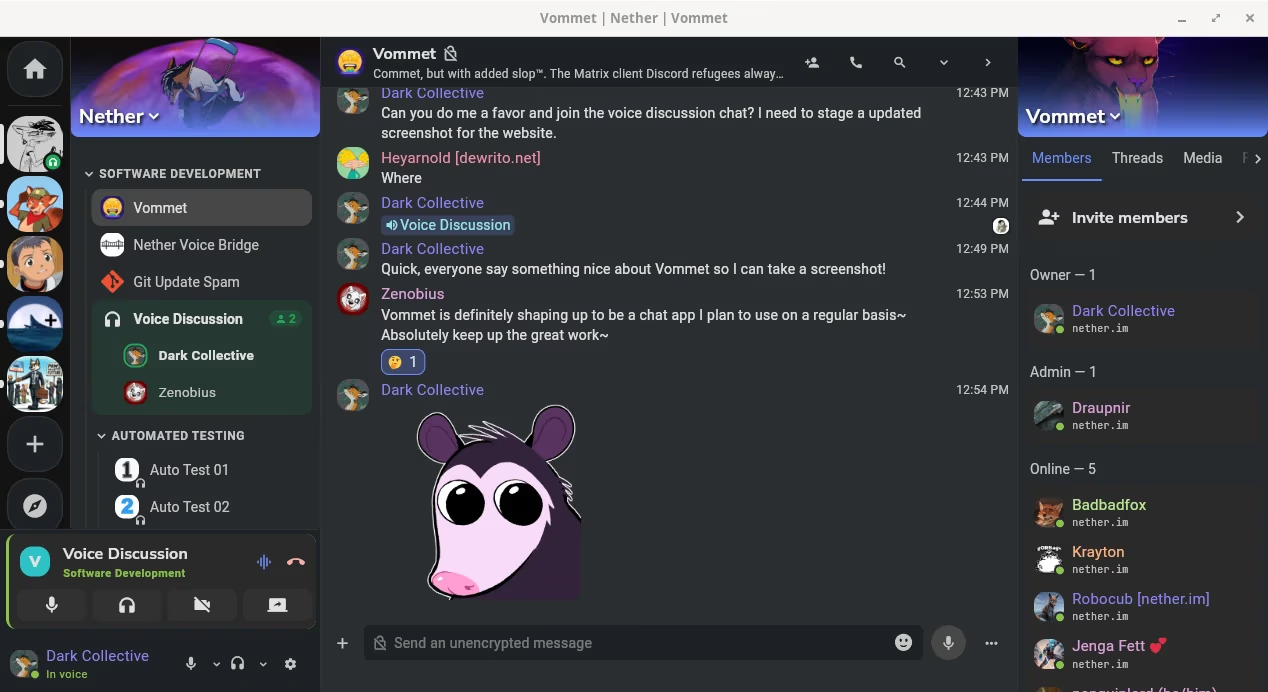
Vommet is an LLM-assisted fork of the excellent Commet Matrix client. I run a large Discord community I've been trying to move to Matrix for years, but no matter what client we tried, people kept bouncing off it. Everyone had a missing feature (Telegram sticker packs, screen sharing with audio on Linux, UI friction, etc.) that sent them back to Discord, even as recent policy changes have left many of our members wishing for a real alternative. So I've been working with community members one by one, finding every missing feature, bug or UI wart that makes Matrix hard to use, and fixing it.
Commet doesn't accept LLM contributions, which we respect, so nothing goes upstream. The name is a joke about AI slop and our rapid release cadence. But like the title says, it doesn't suck. Actually, we think it's really, really good.
Voice and calls
Discord-like voice rooms with a "Voice Connected" card, mute and deafen next to your name, and volume sliders
Push to talk, with a key that works while you're in a game (Windows and X11) and a hold-to-talk button on phones
Watch streams like Discord, plus screen sharing with audio: on Linux, pick any app's audio or everything except voice chat apps
Noise suppression in calls (RNNoise or DeepFilterNet3)
Calls in any room or DM, not just voice rooms
Voice chat with your Discord friends using Nether Voice Bridge
Chat
Mass-import your favorite sticker packs from Telegram (and Signal), right in the app, into shareable sticker rooms
Several pictures posted together show up as one Telegram-style mosaic, and you can flip through a room's pictures like a gallery
Send messages while offline, like Telegram: they go out when you're back, even after a restart
Better thread support, with several display modes for thread cards
Voice messages, and (just landed, desktop only so far) on-device transcription like in Telegram
Spoilers on pictures, bridged GIFs that actually play as GIFs, and plain example.com text turned into links like on Telegram
Forwarding, drafts, multi-select, a formatting bar, and Discord-style <t:timestamp> times shown in everyone's own time zone
People and spaces
Explore: browse any homeserver's public room directory, and peek inside a space before you join it
See which spaces and rooms you share with someone on their profile
Block people, with a clear "You blocked" notice in the DM
Get banned from a room and it stays in your list, greyed, with the mod's reason, so you can keep reading until you choose to leave
Banners for spaces and rooms, and better nested subspaces
When joining a space, pick which of its rooms and subspaces you join
Look and feel
Lots of UI improvements (see the screenshots on the website). When in doubt I rip off Discord, the good parts at l
https://matrix.org/blog/2026/10/16/this-week-in-matrix-2026-10-16/
#rss #feeds #linksharing #qwibbit