
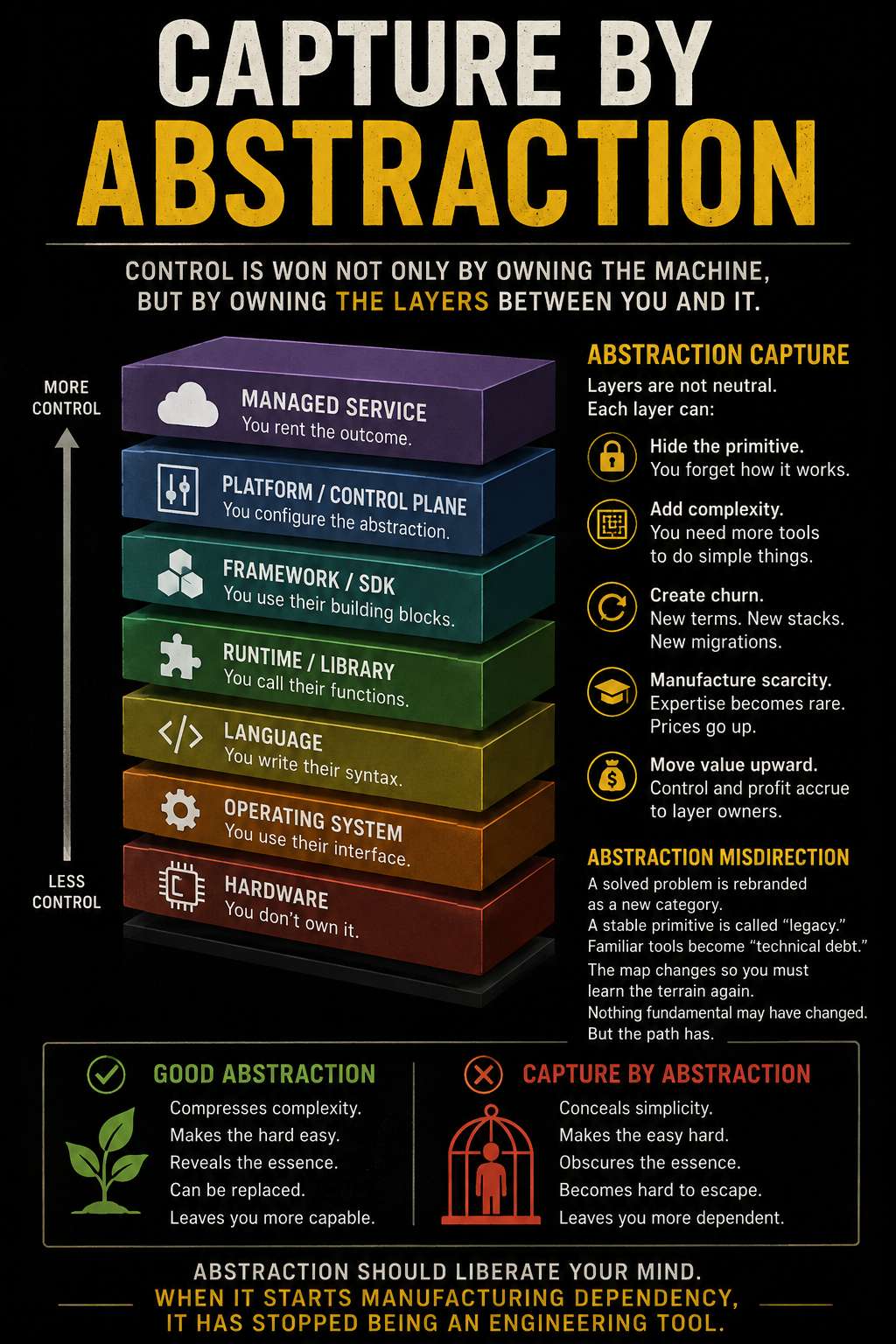
Software does not always capture you by owning the machine.
Sometimes it captures you by owning the layer through which you are allowed to understand the machine.
The hard problem gets solved.
Then an abstraction is placed over it.
Then another abstraction is placed over that.
Soon the engineer no longer works with the primitive.
They work with the framework.
Then the platform.
Then the managed service.
Then the proprietary control plane explaining the abstraction that replaced the abstraction.
This is abstraction capture.
And abstraction misdirection is how it stays justified.
A solved problem is presented as a new category.
A stable primitive becomes “legacy.”
A familiar stack becomes “technical debt.”
The replacement arrives with new terminology, new certifications, new dependencies, new migration work and a fresh scarcity of expertise.
Nothing fundamental may have changed.
But the map has changed enough that everyone must learn the territory again.
That resets accumulated knowledge.
It creates churn.
It turns engineering memory into depreciating capital.
And it moves control upward toward whoever owns the newest abstraction layer.
Good abstraction removes unnecessary complexity.
Capture by abstraction does the opposite:
It hides simplicity behind enough machinery that access to the simple thing becomes commercially valuable again.
The deepest form of platform capture is not locking you into a product.
It is convincing you that the primitive underneath it is too difficult, too old, or too dangerous to touch directly.
Abstraction should compress complexity.
When abstraction starts manufacturing dependency, it has stopped being an engineering tool.
It has become a control surface.
#Software #ComputerScience #Abstraction #Engineering #TechnicalDebt #PlatformEconomy #OpenSource #SystemsThinking