
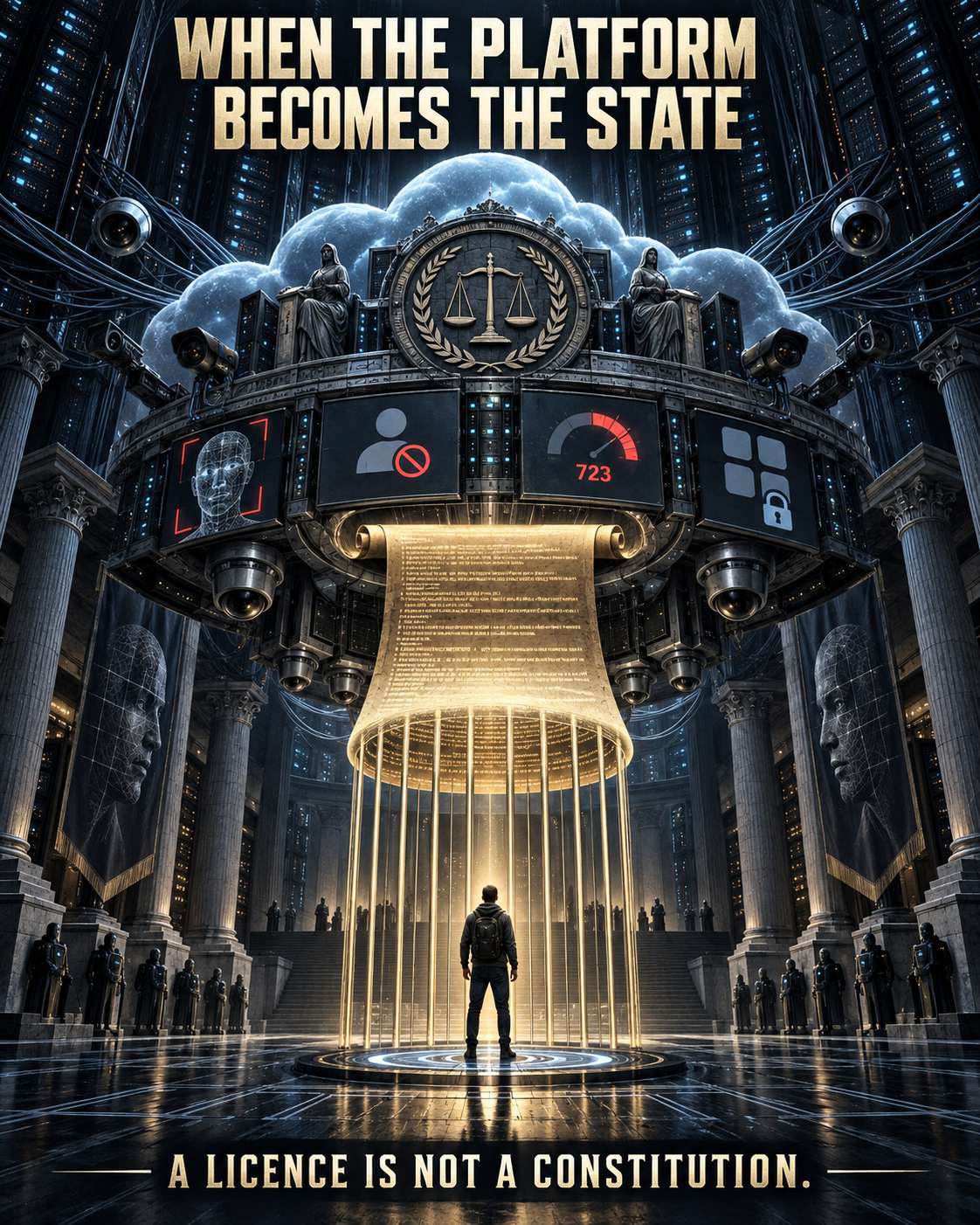
Identity is authenticated through privately controlled devices. Public speech travels through privately governed platforms. Payments depend on proprietary operating systems and app stores. Evidence lives in commercial clouds. Location, health and behavioural data pass through vendor infrastructure. Increasingly, access to work, banking and public services requires compliance with software nobody voted for and few officials can meaningfully inspect.
This creates a constitutional risk without requiring a conspiracy.
A constitution limits public power through jurisdiction, due process, transparency, appeal and institutional separation. A software platform is governed by licences, technical permissions and commercial policy. Its decisions may be immediate, automated and difficult to challenge.
When the state builds itself upon that platform, public authority inherits private architecture.
The individual can then be:
• identified without meaningful anonymity
• profiled without being accused of anything
• restricted without receiving a hearing
• excluded without a judicial order
• monitored without knowing which systems are communicating
• denied access because an automated risk model produced the wrong result
• forced to accept changing licence terms merely to remain socially functional
The danger is not simply that corporations possess too much data. It is that private systems can become the practical boundary of citizenship while remaining legally described as optional consumer products.
A government may be restrained by constitutional law, yet still obtain the practical effect of unrestricted power through infrastructure whose permissions are written in code and whose sanctions are called “service decisions.”
At that point, the licence begins to resemble law—but without democratic enactment. The account becomes an identity document. The device becomes a checkpoint. The platform becomes a jurisdiction. “Accept” becomes coerced consent. Disconnection becomes a form of civil exclusion.
The answer is not the abolition of technology. It is constitutional discipline at the infrastructure layer:
Public power must remain auditable. Essential services must be interoperable. Automated decisions must be explainable and appealable. Citizens must retain meaningful offline and open-standard alternatives. No vendor should possess an unreviewable power to erase a person from functional society.
If government cannot operate independently of a corporation, the corporation is no longer merely a contractor.
It has become an unelected chamber of government.
#BigTech #DigitalRights #ConstitutionalLaw #CivilLiberties #DigitalIdentity #Privacy #DueProcess #OpenStandards #DigitalSovereignty #RuleOfLaw